
[UPDATE: The NFL just announced that the salary cap will be at the lower end of expectations at $301m]
We are currently in the NFL silly season before the league new year begins on March 11, 2026 at 4pm. This is the time for everyone to argue about trades and salary cap space with most not having the slightest idea how it all works. Even worse than having no idea is having some idea and filling in the gaps yourself. I hope this helps with the basics…
League New Year and the Salary Cap
Let’s start with that date above, March 11. At 4pm that day, all NFL teams must be below the salary cap. It doesn’t matter that the Cowboys and Vikings are $30m+ over the cap right now, because by that date they will be far under. If they aren’t, the NFL could issue fines, void contracts, and take away picks. Nobody wants that. We’ll get to how they do this in a minute.
4pm is also the time that teams can officially come to agreements with free agents. There is a moratorium period beginning on March 9th where teams and free agents can negotiate and handshake agree to deals, but they can’t sign the contracts until 4pm on March 11.
Each Team Has Its Own Cap
Despite the league new year being right around the corner, no one officially knows what the salary cap will be. Weird right? The NFL sends memos estimating the number throughout the year. Most recent reports have the number between $301m and $305m, but the final number won’t come out until a few days before the new year.
The funny thing is, whatever number they land on (depends on revenue and whatnot) will not be the number your favorite team must comply with. Why? Because each team can rollover cap space from the previous season. This is a tricky process that must be gamed before the final week of the regular season, but essentially if you have $10m in cap space from the previous year, you can use that money the next season. There are safeguards in place to prevent teams from regularly not spending by the way.
Right now, the average cap projection for 2026 is $303m. The Eagles have around $10m in rollover. They will be dealing with somewhere around $313m but that number will change before it is finalized.
Vocabulary
Yay! Who doesn’t like a good grammar lesson? Unfortunately, vocabulary is incredibly important for understanding the cap. Nothing too heavy here, but it is crucial not to confuse two specific terms: salary and bonus.
The most misused term is salary. “Salary” is not how much cash a player makes in a given year. Instead, it is very specifically about game checks and how much a player earns each week he is on a roster1 (including injured reserve). Salary is paid by the team the player is on and earned throughout a season. For cap purposes, it is accounted for LIVE. What does this mean? If a player gets traded midway through a season, the salary that he earns with the original team counts towards the original team’s cap while the salary they make playing for the new team counts toward the new team’s cap (unless they agree otherwise). The same cannot be said for bonuses.
A bonus is an upfront payment that is earned the minute it is received. If a player has a signing bonus, that means the minute they sign that contract they are owed that bonus. An “option bonus” is like a signing bonus but is one that comes later rather than upon signing. Some options are true options in that it is up to the team to actually exercise the option or not, others are contractually obligated to be exercised on a certain date.
Cap “Magic”
So how do teams make money disappear for accounting purposes? It’s not magic, it is simply about which category you place the money in.
A year’s salary counts for this year, all of it. If a player has a $10m salary, then that money counts $10m against the current cap. If it is a 4/$40m salary with ZERO bonus distributed evenly each year, then each year would count as $10m. It does not have to be distributed equally though. Teams regularly back load contracts, let’s say $2m in year one, then $8m in year two, $10m in year three, and then $20m in year four. Each season’s salary would be that season’s cap hit. Easy peasy.
A bonus, despite getting paid right away, is pro-rated for the length of a contract up to 5 years. So, if a player gets a signing bonus, that money is paid up front, but it is cut into equal portions for accounting purposes. In an evenly distributed contract, this does not create any opportunity for cap shenanigans.2 However, let’s say it’s a 4/$40m contract with a $10m bonus but it came with yearly salaries of $2m, $4m, $4m, and $20m. That bonus prorates to $2.5m and the cap hits become $4.5m, $6.5m, $6.5m, and $22.5m.
Those are the basics, now let’s get to the fun part. You’ve heard of restructuring, right? This is converting a salary into a bonus. A player still needs to make the league minimum salary which is a little under $1m (using this number for math purposes). Let’s use year 2 above for example. That $4m salary drops to $1m with the remaining $3m prorating over the remaining 3 years of the deal. The cap hit that year goes down to $4.5m but the next 2 years go up to $7.5m and $23.5m. You can only restructure salary, not bonus because it has already been paid.
Now for one of the Eagles favorites, void years. A void year is an extra year in a deal that contractually will not count. Basically, it is there for accounting purposes, but the sides agree that it will not count. You can have up to 5 void years. In the 4-year contract above let’s say it has 5 extra void years. Instead of the bonus prorating over 4 years, it gets to breathe over 5 instead lowering the cap hit from $2.5m per season to $2m. In the restructure, instead of $3m distributing over the 3 remaining years, it also gets the full 5; that’s $.6m per year instead of $1m.
One last thing, the option bonus. The best way to look at the option bonus is a “pre-restructuring.” Let’s give our 4/$40m example the works: $10m signing bonus, $1m salaries each season, 5 void years, and $8.67m options each of the last 3 seasons. What do the cap hits look like here?
- Year 1: $1m salary + $2m prorated signing bonus = $3m
- Year 2: $1m salary + $2m prorated signing bonus + $1.73m prorated 1st option bonus = $4.73m
- Year 3: $1m salary + $2m prorated signing bonus + $1.73m prorated 1st option bonus + $1.73m prorated 2nd option bonus = $6.46m
- Year 4: $1m salary + $2m prorated signing bonus + $1.73m prorated 1st option bonus + $1.73m prorated 2nd option bonus + $1.73m prorated 3rd option bonus = $8.19m
- Void Years: $0 salary + $2m prorated signing bonus + $3.46m remaining prorated 1st option bonus + $5.19m remaining prorated 2nd option bonus + $6.92m remaining prorated 3rd option bonus = $17.57m
The Bill Comes Due
That last number isn’t too fun right? That’s the dead money. There are ways to deal with this including extensions, a dummy year (not a void year!), and postponing void dates, but that’s for another article (probably next week).3 This is the price of fancy accounting though. All the money has to be accounted for.
All the money needing to be accounted for is especially true for trades. When a team makes a trade, they are only trading money that has not been paid yet. This means the new team has nothing to do with a signing bonus. That’s completely on the original team and goes right to the top of the cap because there are no remaining years on their contract anymore. Think of it like they traded those years too. This is also true for triggered option bonuses. They are still the responsibility of the original team and also accelerate to the top of the cap. The option bonuses that have not yet been triggered travel with the player to the new team like the salary because they have not yet been paid.
I hope this helps. It seems confusing, but focus on the difference between salary and bonus and you should be fine. If someone uses these terms interchangeably, that’s an easy way to spot someone who does not know what they are talking about.
Spotrac.com and Overthecap.com are the best places to get your information on these things. They are my bibles basically.
- If a player has a guaranteed contract, then even if they are released, they still count against the cap. ↩︎
- $10m bonus on a 4/$40m contract means $2.5m pro rated bonus each season with a $7.5m salary, so still $10m. ↩︎
- Also for another article: the Top-51 rule, June 1 cuts, and the art of incentives ↩︎
Eagles Posts
-

Identifying the usual suspects behind the negative Jalen Hurts opinions. Plus the week’s news
-
The Eagles will never be desperate as long as Howie Roseman is in charge
-

Reporters lay out the years and dollars on extensions and we just take it how it is. Even knowing the ins and outs of signing bonuses and void years, they are still blatantly misreporting the terms of the agreements in these ways and it kills me!!!
-
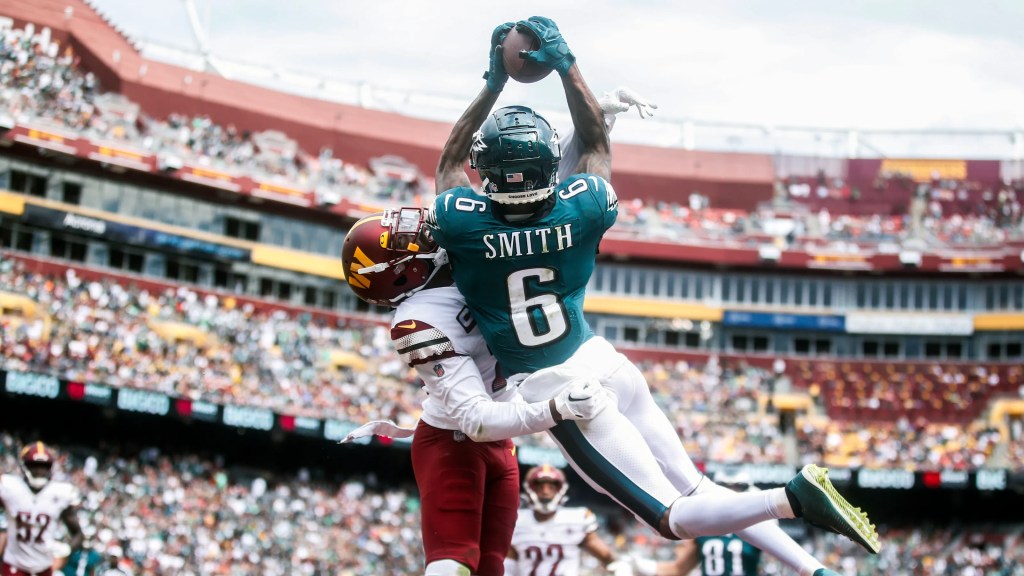
Are people aware of the discount DeVonta Smith took to stay with the Eagles?
-

The Eagles had some holes to start the season and Howie is steadily filling them with solid talent. There are more moves to come to fill the rest of the gaps.
-

Here is everything you need to know about why the Eagles and Dallas Goedert are MUTUALLY agreeing to delay his free agency
-
Catching up with Eagles offseason moves and how they affect the Salary Cap
-

Catching up and projecting out from the first 2 days of NFL Free Agency
-

Free agency news and rumors over the next 2 days with how everything affects the Eagles.



 Philly Front Office
Leave a comment