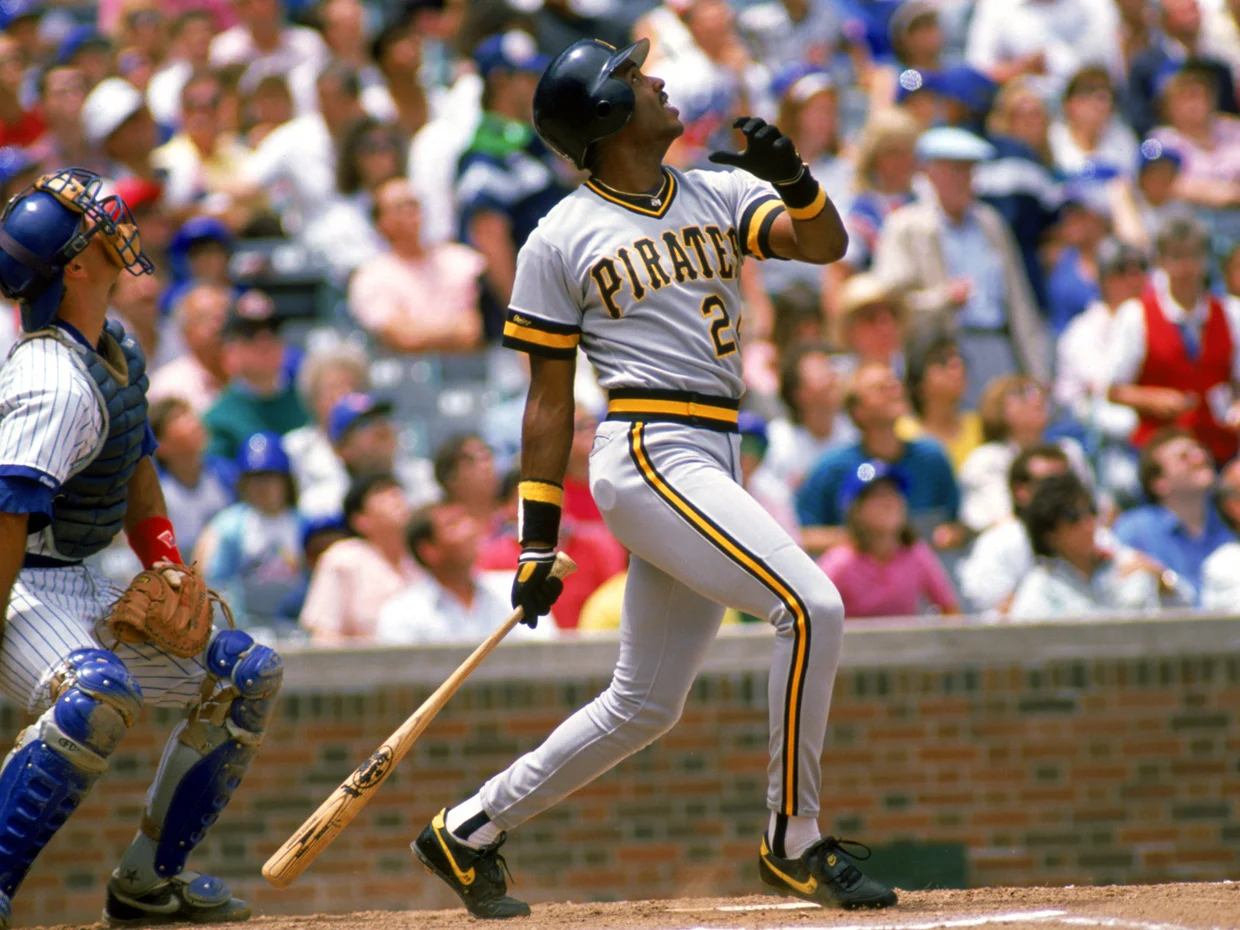
One of my favorite things is to go to baseballreference.com and just look up stats (almost as fun as going to Spotrac.com and looking up contracts). I know, I’m a walking party. Sometimes it’s cool to remember certain guys were on obscure teams or started their careers somewhere you didn’t remember, but really going on that website is an overload of stats. On some pages there are bold numbers which means that player lead the league in a certain category. Then there are pages like Mike Trout, Ted Williams, and Barry Bonds where is more bold than regular type. It’s downright amazing to see the statistical seasons these guys had. Since the Phillies are playing the Pirates, let’s take a look at Barry and what he did before his head doubled in size literally and figuratively.
Barry Bonds – Pirates – 1986 to 1992
Barry Bonds was drafted out of high school ironically by the San Francisco Giants in 1982. He didn’t sign and enrolled at Arizona State University where he starred for 3 years before getting drafted #6 overall in the 1985 draft. He played 71 games in A Ball (OPS .930) during his draft year. He started the next year in AAA, demolished it (.963 OPS), and was called up on May 30, 1986 just a few weeks shy of his 22nd birthday. Despite leading all NL rookies in WAR at 3.5, he finished 6th (!) in 113 games. Todd Worrell and his 36 saves for the Cardinals won the award somehow. Not counting his one season missed almost entirely to injury, that 3.5 WAR was the lowest he would have until his final year in baseball (3.4 WAR) at 43 years old.
5 Players drafted ahead of Barry Bonds in 1985:
16. Phillies – Trey McCall (spoiler alert: he didn’t make it)
1. Brewers – BJ Surhoff
2. Giants – Will Clark
3. Rangers – Bobby Witt
4. Reds – Barry Larkin
5. White Sox – Kurt Brown (?)
Barry’s next 3 seasons he didn’t garner a single MVP vote and didn’t lead the league in any statistical categories despite racking up 20.1 WAR including an 8 WAR season. Those years he was still stealing more bases than he was homering, but the foundation was being laid for one of the biggest breakouts in baseball history. It should be noted that the team went from 57 wins the year he was drafted up to 85 wins in his 3rd season (1988). Also in that 3rd season, he walked 72 times and struck out 82 times. That would be the last season of his career he would strike out more than walk.
In 1990, everything changed. The Pirates won 95 games and Barry won his first MVP award, getting 23 of 24 first place votes (his teammate Bobby Bonilla got the other). He won the Silver Slugger and Gold Glove, made it to his first all-star game (but didn’t start), and started filling up his baseball card with bold black numbers. His 9.7 WAR lead the league, as did his .565 slugging percentage, .970 OPS, and his 170 OPS+ (they are two different things completely despite the names, btw).
In 1991, he led the league with 8 WAR, won another Silver Slugger and Gold Glove, and finished 2nd in MVP voting, losing in an incredibly tight race with the Braves’ Terry Pendleton who led the league in hitting, but was dwarfed in WAR and OPS. Barry led the league in OBP, OPS, and OPS+ which he would do 3 years in a row. He struck out 35 times less than he walked. Shockingly, no all-star game.
1992 would be his final year in Pittsburgh, not surprisingly it was his best. He won his 2nd MVP award, this time trouncing Pendleton in second place. He raised the bar though, destroying everyone that season in all of the all around statistical categories:
- WAR: Barry 9.0; Ryne Sandberg 7.8
- OBP: Barry .456; Frank Thomas .439
- Slugging: Barry .624; Mark McGwire .585
- OPS: Barry 1.080; Thomas .975
- Runs (NL): Barry 109; Dave Hollins (!) 104
- Walks: Barry 127; Thomas 122
- HR (NL): Fred McGriff 35; Barry 34
- OPS+: Barry 204; McGwire 176
That OPS+ stat is an important one. It measures a player’s productivity compared to other players and adjusting for ballparks, 100 is average. Barry was worth 2 players!!! His 204 OPS season ranks 83rd all time behind some of the all-time names of baseball including himself.
Friday, June 6 at 6:40p – Joe Ross v. Bailey Falter
Phillies at Pittsburgh
Saturday, June 7 at 4:05p – Ranger Suarez v. Andrew Heaney
Sunday, June 8 at 1:35p – Cristopher Sanchez v. Paul Skenes
Unfortunately, that 1992 season famously ended in the NLCS after Barry’s throw in the bottom of the 9th inning failed to get Sid Bream out at the plate following a single by the Braves’ Francisco Cabrera that tied the game at 2 and then won the series in 7 games. It would be Barry’s last memory as a Pirate.
During his career in Pittsburgh, Barry apparently reached out to Pirates ownership about a contract extension but was rebuffed. He famously feuded with the team and the media after that. Things got contentious. Before he left he was quoted as saying “And if I do leave, I’ll haunt the Pittsburgh Pirates. They’ll be the one team I beat up on.” That’s an understandable statement, but hardly something that feels good as a fan.
That off-season, Barry signed a 6/$43.75m contract with the San Francisco Giants. It was the biggest contract in baseball history both in total dollars and AAV. Pittsburgh never has and never will pay that kind of market breaking money to its players. They didn’t pay Cy Young winner Doug Drabek that year either, just like they didn’t pay Bobby Bonilla the year before. The Pirates wouldn’t finish above .500 or make the playoffs again for 21 years.
In just his 7 years as a Pirate, Barry finished with the following stats:
- WAR: 50.3
- Runs: 672
- HRs: 176
- SBs: 251
- Walks: 611
- Avg: .275
- OBP: .380
- Slug: .503
- OPS: .883
- OPS+ 147
- MVPs: 2 (1 runner up)
For everyone who thinks Barry Bonds doesn’t deserve to be in the Hall of Fame, I get it. The stats with the Giants were video game numbers. He was an a-hole too. His time with the Pirates might be enough anyway though. Barry Bonds was that good.
Leave a Reply