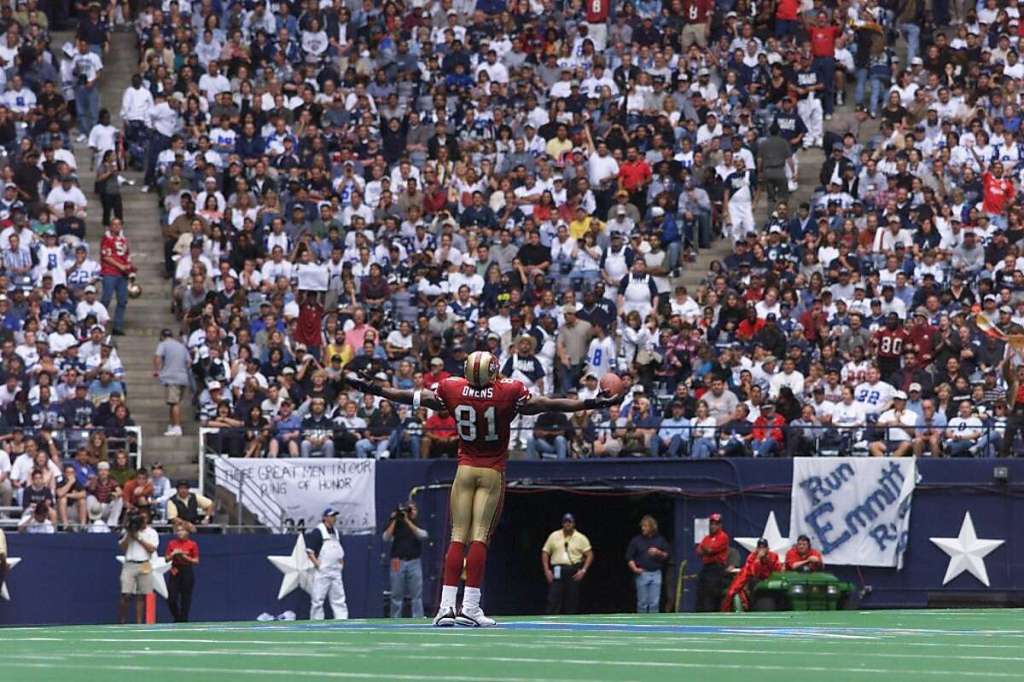
It seemed almost too perfect. The Eagles were in desperate need of a high end wide receiver and maybe the best one in the NFL was set to become a free agent. There was mutual interest too. As essentially a formality, all Terrell Owens had to do was file the paperwork to void the final 3 years of his contract with the SF 49ers and there would be nothing stopping him from coming to the Eagles. Then everything went wrong.
The Contract
Back in 2004, players with the option had until March 2 to void their contract and apply for free agency as per the 2001 edition of their Collective Bargaining Agreement. For some reason though, this didn’t govern ALL players. Players with contracts signed before that new CBA had until February 21 to submit that paperwork. Terrell Owens was one of those players. Owens missed his early deadline.
Procedure was that the NFL sends the Players Union a list of those with early opt out dates and the Player’s Union informs the player. Owens’s agent, David Joseph, claims that he never received this letter and was operating as if Owens had until March 2 like everyone else. He filed the paperwork after Feb. 21 but before March 2. Was he a free agent?
Free Agency?
If Owens wasn’t a free agent, then the 49ers still had his rights. Was he supposed to go back to the 49ers? No way. This was the offseason where Owens said his QB Jeff Garcia “walks like a duck and talks like a duck”, had several blow ups on the sidelines, and the 49ers were shedding salary. They wanted him gone. However, they believed that they were just handed a gift, the ability to trade Owens for compensation instead of letting him walk for nothing. On March 4, the 49ers traded Owens to the Baltimore Ravens for a 2nd round pick.
Of course, the story wasn’t over. Owens and his agent refused to go to Baltimore and insisted that he was still a free agent. The NFLPA filed a grievance and Owens continued to negotiate with teams as if he were still available. Not wanting to miss out on the chance to land Owens, the Eagles signed him for 7/$49m.1
What the hell was going on?
The Grievance
NFL players and teams can’t sue one another. Instead, they go to arbitration which is basically a smaller and less formal court system. The argument was pretty simple: did it matter if the agent received the letter?
The reason so many real lawsuits settle before trial is because a real verdict can be unpredictable and extreme for both sides. Attorneys don’t like that kind of volatility. The stakes here were pretty high. In an all or nothing situation, Owens wanted to be in control of his destination and his bank account (considering his old contract was still valid if the deal was allowed to stand), the 49ers wanted their 2nd round pick, and the Ravens and Eagles both wanted their WR savior. If an arbitrator made a decision in the case, someone was going to get very screwed.
Outcome
After 13 days of negotiating, arguing, and lots of media bickering – and before the arbitrator made a decision – on March 16th, the parties reached a settlement: Owens was a Philadelphia Eagle. He couldn’t go for free though. The Ravens would get their pick back and the Eagles would send a 5th round pick and defensive end Brandon Whiting to SF in exchange for Owens.
In the immediate aftermath of the compromise, Philly and Owens were a perfect match. Owens became the prophesized savior in Philly with an unbelievable and transformative season culminating in a Super Bowl appearance in which Owens starred playing on a broken leg. Unfortunately, it would never get better than that first season as Owens immediately demanded a better contract with new agent Drew Rosenhaus and became such a distraction that he was suspended and ultimately released after his second season.
New agent? Oh, you better believe David Joseph was fired. Owens was essentially forced to stick with the guy through the situation but that relationship was over. It had to be. An agent is there not just to negotiate contracts but to avoid situations just like this. They are paid to know the rules and there’s no excuse for not knowing that his client had an earlier deadline than everyone else. There was nothing nefarious about what happened, he just missed the deadline. In court, not knowing something is no excuse unless it was purposely hidden. There’s no doubt in my mind that Owens would have lost the grievance for exactly this reason. So why did they settle? Because Owens had the leverage to simply not report to Baltimore and the temperament to follow through with the threat. A ruling would have caused an explosion.
As a college kid in the early 2000s, getting information on the wheelings and dealings of the NFL was no easy task. We were flying blind as to what was going on, but I just knew that Owens was going to be an Eagle. Even after he was traded to Baltimore, an eventual trip up 95 to Philly had to be in the works. It just had to! Thankfully, it was. Until 2017-18, that first TO season was the best we ever had. As crazy as it started and ended, it was all worth it.
- I’ll go into the real numbers behind this deal another day and why what seemed so big was also a huge underpay just 12 months later. Owens was not only in a rush, but with a panicked agent who got him what seemed like a good deal but really wasn’t. ↩︎
 Philly Front Office
Leave a comment