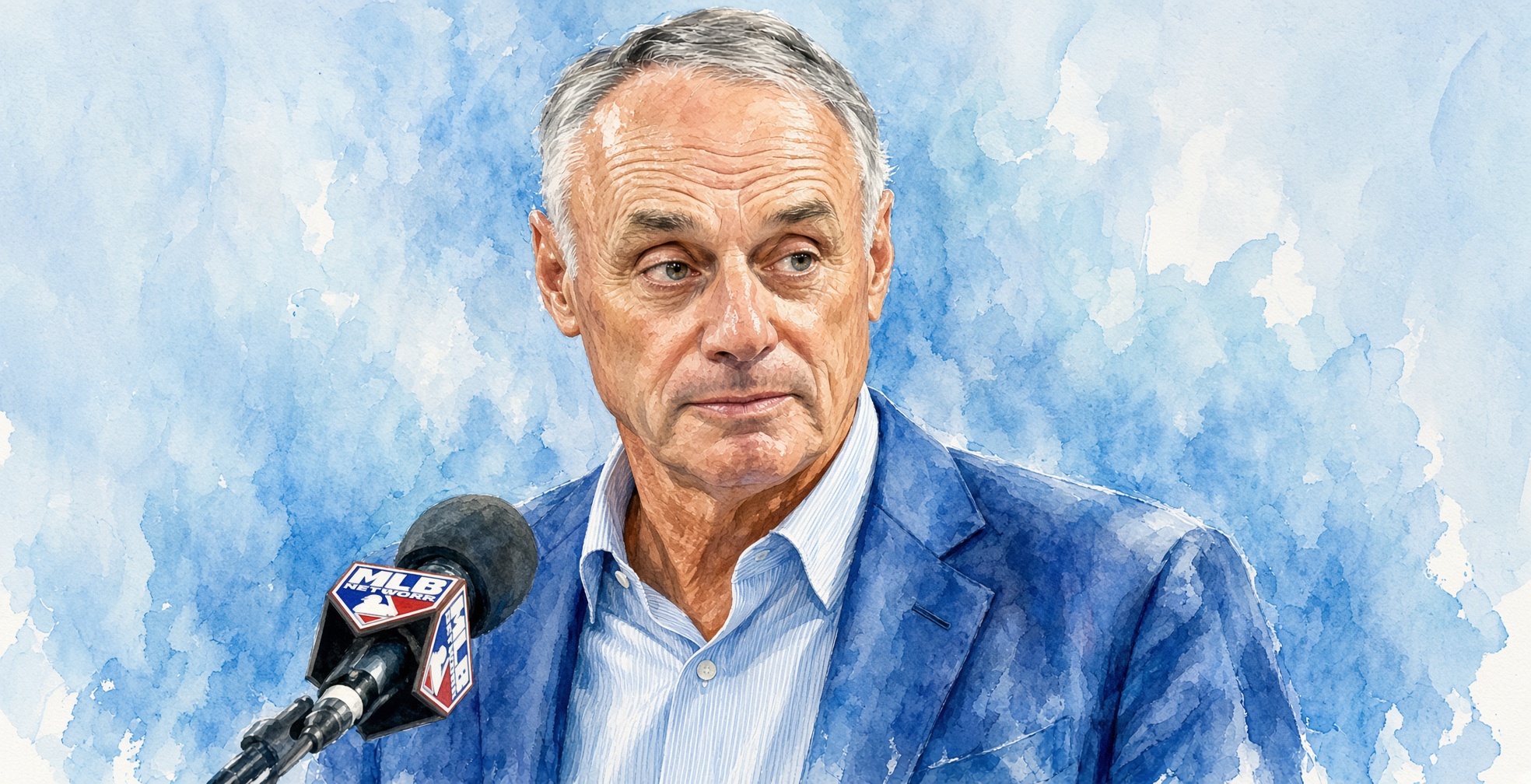
MLB unveiled their latest salary cap proposal to the Players today, offering not to phase in their proposed salary cap until 2028 (or later). Ok, great! There’s just one problem, the Players still don’t want it. This is more to help their fellow owners than actually being some kind of counteroffer. Sure, the Owners gave some crumbs to the Players, but nothing is moving the needle. To avoid losing baseball, they need to try something completely different. I have two possible solutions:
The Non-Cap and Less Service Time
The Proposal
Starting in 2028, Owners want a Salary Cap at $258.2m with a Floor of $180.2m. In exchange, the Owners say they will accept a raise of the league minimum salary, get rid of the Qualifying Offer, and change the years of service time to 5 but only if you are 30 or older. There are other tidbits to this too, but for the most part, that’s the give and take.
Eye for an eye, right? Absolutely not. It is the equivalent of offering Manhattan for some blankets. First, it needs to be noted that the Owners are not raising their cap offer. Instead, the higher numbers are tied to the expected raise in revenue and spending that naturally comes with an additional year. Second, the Owners aren’t actually giving up much of anything. If the Owners REALLY want a salary cap, they are going to have to offer a major concession to the Players. That’s the irony of this whole labor negotiation being framed as a power grab from the Players. They really aren’t asking for much.
The Real Reason There Will Be an MLB Lockout
Related Articles
MLB’s “Level the Playing Field” Campaign is Uneven
Andy Messersmith: The Most Important Player You’ve Never Heard Of
October 7, 1969: Curt Flood Doesn’t Go to Philadelphia
Getting Serious With Real Solutions
Phillies (former?) player rep Garrett Stubbs gave an interview where he said it was frustrating for MLB to not offer any proposals that did not come with a cap. This is (so far) a non-starter for the Players as it has been for over 50 years. If that is what their plan is, then this work stoppage will go on for a long time. The Players will simply not agree to such a massive change out of hand. I’m not saying they will never break, but it would take a long time. Here is how I see this possibly coming to a decently early solution.
Solution #1 – The Non-Cap
From years of dealing with these kinds of things, I learned that when the sides just hate each other, they will have a hard time agreeing no matter what. They just do not want to give in to the other side. This is especially true with the term “salary cap.” It is a major problem because if the Players agree to a cap, they have lost. Whether that’s true or not, that will be the perception. You can’t have that in a good negotiation. Both sides need to feel as if they have achieved something.
While a rose by any other name is still a rose, a salary cap by another name might actually work. What I would propose is something of a non-cap Cap. This is the Owners getting some kind of spending limit without taking away the possibility of higher spending. The NBA calls this a soft cap. They have a top end limit that can be used on free agents, but allows teams to exceed that cap to sign their own players or use other exceptions. If a team spends too much though, the penalties are VERY harsh.
There will be a minimum spending level tied to revenue sharing, then a penalty point where teams simply cannot sign new players to large deals. It will be important to not call this a cap though. From here you can resign your own players but you can’t sign players to deals of more than a certain value. In the NBA, it is called the mid-level exception and you only get one of these deals per year. After a certain level, big penalties will kick in. This is a crude version of the NBA’s complicated system, but it covers the basics.
Yes, some NBA teams are still cheap, but for the most part, every team is in the same ballpark while still being able to spend.
Solution #2 – Less Service Time
A salary cap is a massive ask by the Owners. The Players are really only asking for a greater revenue sharing system which actually benefits most of the owners too. If we really wanted to break this down and assign variables, the Owners are making an S-Tier ask while the Players want C and D-tier items. What would be an S-Tier equivalent for the Players?
The closest thing I can think of is a quicker path to free agency. Right now, the Players are drafted by teams, then go through the minors, then have to wait 6 FULL seasons before reaching free agency. Often this leaves players at risk of not choosing their own path until they are in their late 20s and 30s. In the NFL and NBA, there is no real minor league system and drafted players are under team control for 4 years (5 for NFL 1st round picks). That means ALL players are hitting free agency in their mid 20s, their prime earning time.
How can we change this? The minor league system is simply necessary for players to develop. The reason owners wanted the 6 years is so they could get a good return on their investment in cultivating talent. I’m pro player, but I can understand that. However, you can’t simply get the advantage of minor league time AND 6 years while also getting a salary cap. It is too much control.
How about 3 years? How about a definite age, let’s say 25? This way the Players reach free agency LONG before they would now. Sure the Players get arbitration, but that doesn’t give them any real bargaining power. If the league wants to cap earnings anyway, what would be the big deal about letting players choose their destinations sooner?
Let’s look at the curious case of Kris Bryant. Now he is known for barely playing at all after signing for big money with the Rockies (7/$182m). It is a killer for Colorado. Before that deal though, Chicago refused to bring him up as a rookie until he would not accrue a year of service time. Essentially, the Cubs went from 6 years of control to 7. It was bullshit and everyone knew it. Bryant still won ROY in 2015 then won MVP and brought a World Series to Chicago in 2016. In 2017, he finished 7th in MVP voting. How different would everything be if he had hit free agency at that moment instead of 4 seasons later?
Yes, Bryant made almost $63m in arbitration those 4 years. That’s great and all, but imagine if he had signed the same deal then instead of later when his body was failing him? Instead of being known as a dead weight and a cautionary tale in Colorado, he could have been their own MVP candidate at 26 years old. Oh right, the owners wouldn’t want that. Just like they really don’t want Paul Skenes to be a free agent right now.
The crazy part about this solution is that it might actually get player approval despite not really helping them overall. More players would be fighting over free agent money in this situation. While this would appeal to younger players, it would end up culling the ability for older players to land bonkers deals. That might be a good selling point though for a bigger chunk of the union.
Negotiating Farce
The Owners are currently negotiating to the public right now rather than the Players. They have devoted ad campaigns to convincing the fans that they need a salary cap without actually targeting the players. It’s all nonsense and it is very strange. So far, they haven’t been serious about actually reaching a resolution in the least.
Leave a Reply