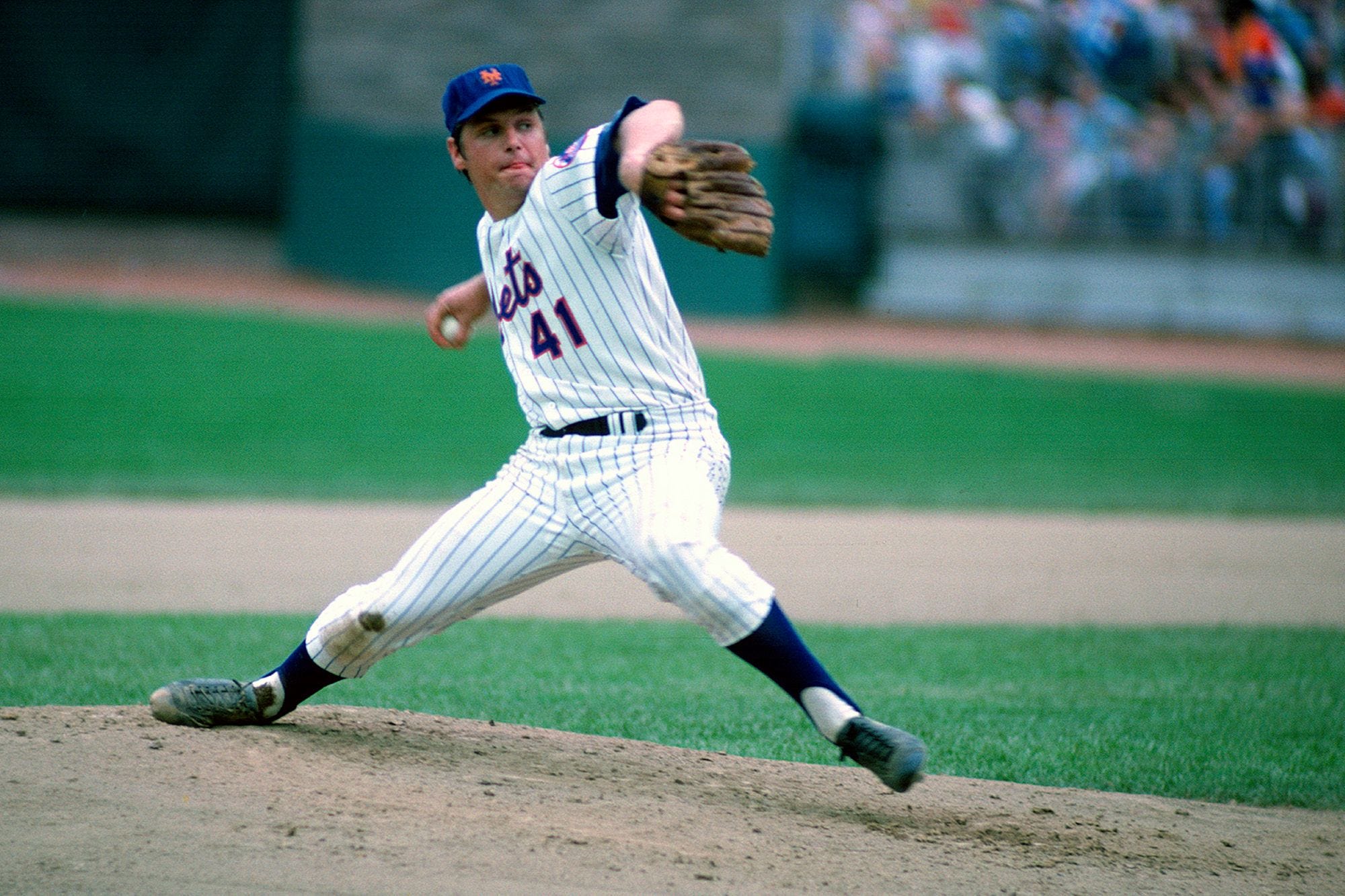
On June 15th, 1977, the unthinkable happened in New York. No, it wasn’t the serial killer roaming the streets and it wasn’t the rolling blackouts plaguing the city. The Mets traded away the best player in franchise history before and since. Pitcher Tom Seaver went from the Mets to the Reds for 4 players you have never heard of (Pat Zachry Steve Henderson, Doug Flynn, and Dan Norman).1 Seaver was maybe the best pitcher in baseball at the time and he was gone. How did this happen?
Thursday, July 16 at 7p – Aaron Nola vs Christian Scott (R)
Citizen’s Bank Park – Philadelphia, PA
Saturday, July 18 at 4:05p – Jesus Luzardo v Sean Manaea (L)
Sunday, July 19 at 1:35p – Alan Rangel v Nolan McLean (R)
When I say best pitcher in baseball and best player in Mets history, this is not hyperbole. In his ten seasons in Queens to that point, Seaver had 71.2 WAR, 182 wins, and a career 2.47 ERA. This is still selling him short. He had 3 Cy Young awards and probably should have had a 4th in 1971 when he had better numbers than Fergie Jenkins including an absurd 1.76 ERA. He led the league in ERA 3x and Ks 5x. Of course, there’s also the 1969 World Series. The Mets were blessed with a superstar in the infancy of their franchise and threw him away. Why?
Almost every baseball transaction from the 1970s is related to the Seitz Decision in someway. This was the arbitration ruling that killed the Reserve Clause and granted free agency to Andy Messersmith specifically, but all MLB players going forward. Seaver is no different.
Shortly after the Seitz decision the Mets acted to keep Seaver from reaching free agency the following year, signing him to a 3/$675k contract. Seaver had been asking for a 3/$825k, but accepted the discount. The $225k per year amount looked great…for 4 days. That’s when Messersmith signed with the Braves for 3/$1m and he was no Tom Seaver. The first real wave of free agency would hit the following offseason with Reggie Jackson becoming the highest paid player in baseball with a 5/$3.5m contract. Payrolls skyrocketed from there.
Upon seeing that he terribly misjudged the market and realizing that he was basically the only reason Mets fans came to the ballpark, Seaver wanted to renegotiate or at least extend his contract at a more of a market rate. However, the head decision maker for the Mets, Donald Grant, refused. Stories were regularly printed in the NYC press labeling Seaver greedy and Seaver would respond by calling out Grant for being cheap (not just for himself but for failing to improve the team2). When his negotiating tactics failed, Seaver went above Grant and straight to Mets’ ownership, Lorinda de Roulet. She and Seaver came to an agreement on a 3/$1.1m contract. That’s when shit hit the fan.
The deal was agreed to in principle on June 13 but not signed. The following day, Daily News reporter Dick Young wrote an article saying that the whole Seaver situation was caused by jealousy from Seaver and his wife over the money his former teammate, Nolan Ryan, was now making with the Angels. Clearly a plant by Grant with his guy at the news desk, Seaver lost it and demanded a trade. The following day, he was gone.
That same night, the Mets traded Dave Kingman who wasn’t having a great year but hit 37 HRs the previous year and would hit 48 in 1979. The press dubbed it “The Midnight Massacre” and the Mets entered a full scale rebuild. It would be 8 seasons before their next winning season. Seaver would finish 3rd in Cy Young voting that season and finish in the top 5, three times while playing for the Reds. He would make $375k per season in Cincinnati before coming back to the Mets in 1983 on a 2 year, $1.6m deal.
The worst part of the Midnight Massacre was the part no one considered at the time. Seaver would get his 3000th career strikeout as a Red. His 300th win would come as a White Sox years later. Fortunately for Mets fans, he went into Cooperstown as a Met, but he never should have left.
- Dave Kingman was traded that night too ↩︎
- The first wave of free agency included a re-entry draft where teams had to basically select who they planned to bid on. The Mets selected ZERO of the 24 candidates ↩︎
Info: SABR
Contract Info: Baseball Reference
Leave a Reply